Holiday Budgeting · 6 min read
Zero-Debt Holiday Budget Guide: 10 Hidden Christmas Costs, Landed Tax Math, Kids 4-Gift Rule & Sinking Fund
By NibPaper Studio · Print-tested · 2026-11-27
Why gift-only Christmas budgets still end in January credit-card debt: all 10 seasonal spending pillars, true landed tax-plus-shipping cost math, the Kids 4-Gift sibling parity formula, and a 12-month cash sinking fund.
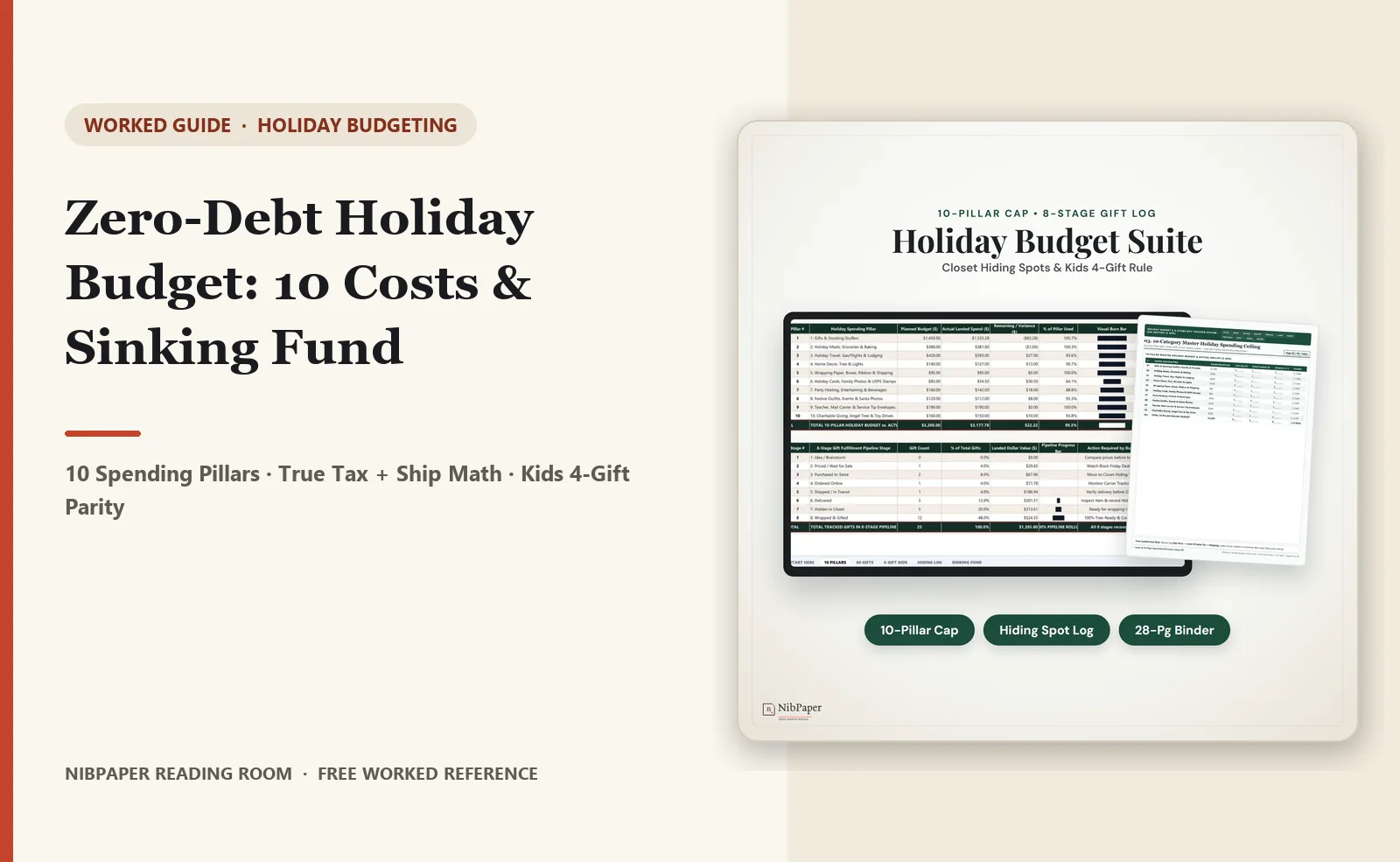
1. Why Gift-Only Holiday Budgets Miss 35% to 45% of Real December Spending
Most households open a blank note in November, jot down ten names beside gift dollar limits, and assume their holiday budget is done. By January 2nd, their credit card statement tells a very different story.
Consumer spending surveys consistently show that non-gift categories (Thanksgiving and Christmas groceries, baking supplies, winter travel, decor, wrapping, shipping boxes, photo cards, postage, outfits, charity, and cash tip envelopes) quietly add 35% to 45% on top of wrapped gifts. Budgeting all 10 pillars upfront turns surprise charges into planned line items.
2. The True Landed Cost Formula & Early Return-Window Guard
Writing '$49.99' beside a Black Friday toy hides what actually left your checking account. Once 7% to 10% US local sales tax and $6.99 shipping (or expedited December delivery fees) hit checkout, a $50 gift costs $61.50. Across 25 presents, ignoring tax and shipping adds $200 to $300 in untracked drift.
Log every purchase at its final receipt total (Landed Spend = Item Price + Sales Tax + Shipping) and record two extra columns the moment the shipping confirmation arrives: the retailer's return-by deadline (per FTC guidance, return windows and restocking rules vary widely by store) and your exact closet, attic, or trunk hiding location so nothing gets misplaced before wrapping night.
3. Keeping Siblings Fair With the Kids 4-Gift Rule (Want, Need, Wear, Read)
Shopping early sales for two or three children easily creates lopsided Christmas mornings where one child gets seven smaller boxes while another receives three pricier ones, or total spend drifts $75 apart across weeks of separate orders.
Assigning every child four intentional slots (1. Something They Want, 2. Something They Need, 3. Something They Wear, 4. Something They Read, plus a capped stocking allowance) puts natural rails on impulse deals. Compare both total landed dollars and wrapped box count side by side in one view before buying a single December add-on.
4. Turning Next Year's Holiday Cap Into a Calm 12-Month Cash Sinking Fund
According to CFPB holiday budgeting guidance, setting a realistic ceiling after core living expenses and deciding how to pay upfront (avoiding stacked Buy Now, Pay Later installments or high-APR balances) is the surest defense against post-holiday debt.
Take your actual 10-pillar holiday total this December and divide it by 12 (or by 26 biweekly paychecks). For a $1,800 family holiday ceiling, routing $150 per month (about $69 per biweekly paycheck) into a dedicated high-yield savings bucket starting January 1 means next November's entire season is 100% cash-funded before the first sale email arrives.
Worked Example · Quick Reference
Sample 10-Pillar US Family Holiday Budget ($1,800 Ceiling -> $150/Month Sinking Fund)
| Holiday Cost Pillar | Sample Cap ($) | Share of Budget | Practical Zero-Debt Control |
|---|---|---|---|
| 1. Gifts & Stockings (Landed) | $900 | 50.0% | Include US tax + shipping; cap kids via 4-Gift Rule |
| 2. Holiday Meals & Baking | $240 | 13.3% | Separate Christmas roast & baking from normal groceries |
| 3. Travel, Gas & Lodging | $160 | 8.9% | Factor winter fuel, tolls, parking & pet sitting early |
| 4. Home Decor, Tree & Lights | $75 | 4.2% | Audit stored decor bins before buying new ornaments |
| 5. Wrapping, Boxes & Postage | $65 | 3.6% | Ship early via Ground Advantage to dodge rush fees |
| 6. Cards, Photos & Stamps | $55 | 3.1% | Order by household count, not individual headcount |
| 7. Party Hosting & Drinks | $85 | 4.7% | Use potluck signups for drinks & side dishes |
| 8. Festive Outfits & Photos | $60 | 3.3% | Reuse core pieces; skip last-minute rush orders |
| 9. Teacher & Service Tips | $90 | 5.0% | Pull crisp cash bills once on a single bank teller slip |
| 10. Charity & Toy Drives | $70 | 3.9% | Plan giving upfront so generosity never causes guilt |
Illustrative US household allocation for personal organization and educational budgeting only (not licensed financial advice). Scale each pillar to your own income after essential bills.
Save or share this guide
Pin it to your board for later or pass it along to someone who needs it.
Common Questions
Frequently Asked Questions
How much should a family save each month for a Christmas sinking fund?
Divide your realistic 10-pillar holiday ceiling (including gifts, hosting groceries, travel, decor, shipping, cards, and tips) by 12 months, or by 26 if paid biweekly. For example, a $1,200 total holiday cap equals $100 per month ($46 per biweekly paycheck), while an $1,800 cap equals $150 per month.
What are the most common hidden holiday costs that break Christmas budgets?
The biggest budget leaks outside wrapped gifts are local sales tax and expedited shipping (often 10% to 15% extra on online orders), holiday hosting groceries and baking ingredients, wrapping paper and postage boxes, greeting cards and stamps, winter travel fuel, and teacher or service-worker tip envelopes.
What is the Kids 4-Gift Rule for Christmas budgeting?
The Kids 4-Gift Rule structures each child's main presents into four meaningful categories: Something They Want, Something They Need, Something They Wear, and Something They Read. Pairing those four slots with an equal per-child dollar cap keeps sibling Christmas mornings balanced and prevents impulse overspending.
Official Primary References
- Your Money, Your Goals: Cash-Flow Budgeting & Savings Tools(Consumer Financial Protection Bureau (CFPB))
- Shopping, Returns & Consumer Protection Guidance(Federal Trade Commission (FTC))