Wedding Stationery · 7 min read
How to Word a Multicultural Multi-Day Marriage Invitation & Manage 3-Event RSVPs (Nikah, Vivah, Sikh, Catholic & Bilingual Etiquette)
By NibPaper Studio · Print-tested · 2026-11-28
Navigate split both-parents hosting, sacred cultural headers, tiered Mehndi/Nikah/Vivah/Walima guest lists, polite reserved-seat phrasing, 9:16 WhatsApp family evites, and household envelope math so every family feels honored with zero print waste.
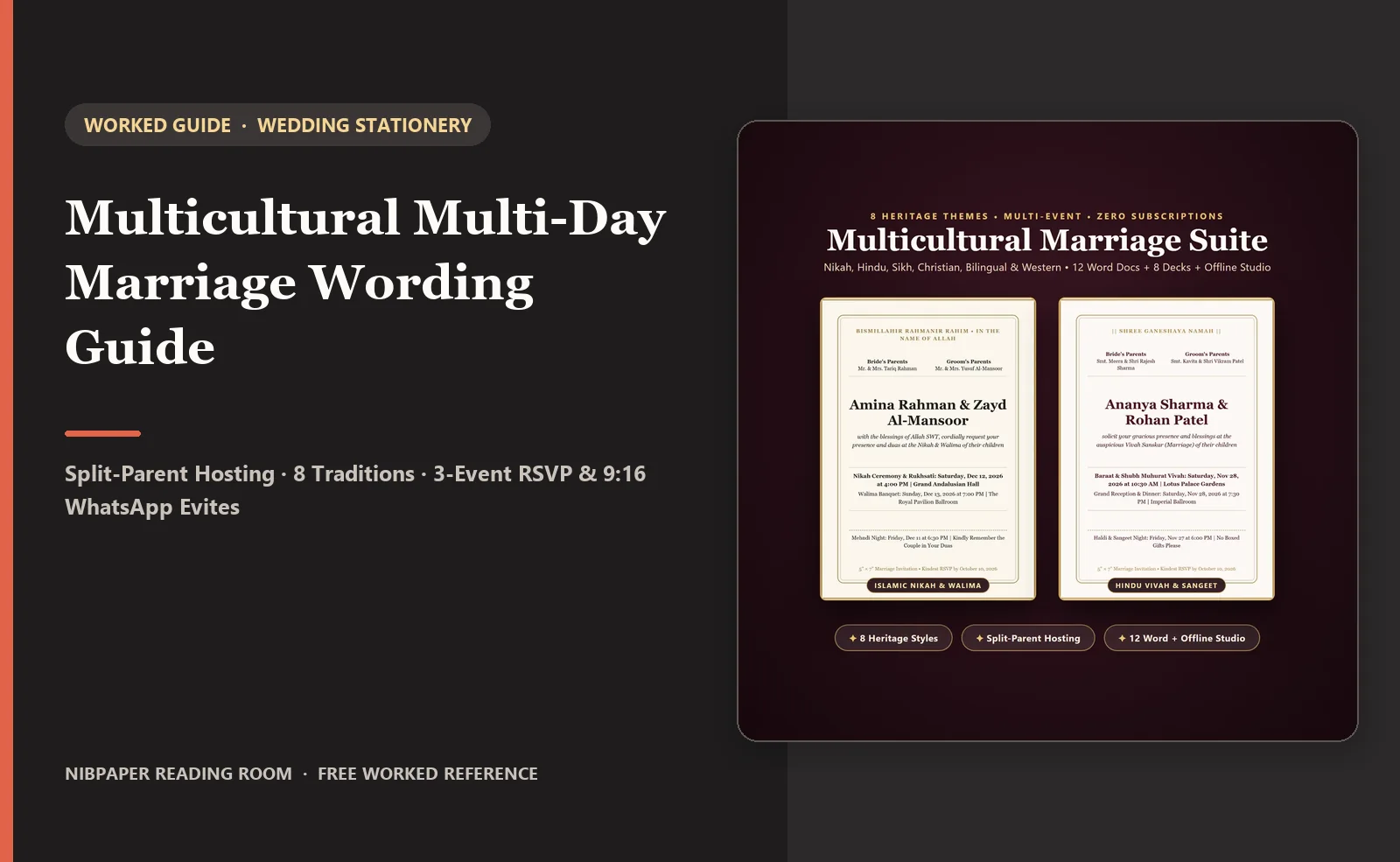
1. Equal Split-Parent Hosting & Respectful Cultural Blessing Headers
Standard Western invitation scripts place only the bride's parents at the top, which immediately creates friction in South Asian, Middle Eastern, Catholic, and blended multicultural weddings where both families co-host multi-day celebrations.
Solve the hierarchy cleanly with a balanced 2-column host header (Bride's Parents on the left, Groom's Parents on the right) tucked right below your chosen cultural header: Bismillahir Rahmanir Rahim for Islamic Nikah & Walima, Shree Ganeshaya Namah for Hindu Vivah, Ik Onkar for Sikh Anand Karaj, or Together With Their Families for interfaith and modern Western ceremonies.
2. Tiering a 3-Day Multi-Ceremony Guest List Without Awkwardness
Multi-day celebrations like Mehndi, Haldi/Sangeet, Rehearsal Dinner, Nikah/Vivah/Nuptial Mass, and Walima or Grand Reception rarely share one identical guest list. Putting an intimate Friday Mehndi time onto every guest's main 5×7 card leads to accidental over-capacity crowds.
Use modular enclosure cards instead. Keep the formal 5×7 invitation focused on the core marriage ceremony, and print two or three clean versions of your 4×6 Multi-Ceremony Schedule and 3.5×5 RSVP card (Tier A: All 3 Events for inner family; Tier B: Ceremony + Reception for friends; Tier C: Walima/Reception Only for extended colleagues).
3. Tactful Reserved-Seat, Adults-Only & 'No Boxed Gifts' Etiquette
Setting polite boundaries early saves weeks of awkward phone calls. Never place 'No Kids' or gift notes on the front of the formal 5×7 marriage card; place them warmly on the RSVP or 4×6 Details insert instead.
Use the classic gold-standard RSVP line ('We have reserved ___ seats in your honor') paired with explicit envelope addressing ('Mr. & Mrs. Tariq Rahman' rather than 'The Rahman Family'). For cultural celebrations where envelopes or blessings are customary, phrase gift notes gently on the details card, such as 'Your presence and prayers are the greatest gift; kindly, no boxed gifts.'
4. Pairing 2-Up Home Cardstock Prints With 9:16 WhatsApp Evites & Envelope Math
Many multicultural weddings mail printed 5×7 suites domestically (US A7 5.25×7.25" or ISO C5 162×229 mm envelopes) while inviting aunts, uncles, and elders abroad over WhatsApp where international mail takes weeks. Sending a tiny horizontal PDF forces older relatives to pinch-zoom on small screens.
Export a dedicated 1080×1920 (9:16) high-resolution vertical smartphone card alongside your 2-Up US Letter or ISO A4 print sheets (which cut 100–110 lb cardstock costs in half). Before hitting print, deduplicate your guest list by Household ID: 150 guests typically require ~80 envelopes plus a 15% overage buffer (~92 total suites), saving hundreds on printing and postage.
Worked Example · Quick Reference
Multicultural 3-Event Wedding Stationery, Sizing & Household Print Matrix
| Stationery Piece / Tradition | Exact Card & Envelope Spec | Guest / Tiering Rule | Etiquette & Print Tip |
|---|---|---|---|
| 5×7" Main Marriage Card | 5.0×7.0" (+0.125" bleed) -> US A7 / C5 | 1 suite per Household (+15% buffer) | Use 100–110 lb matte cover; 2-Up cuts paper 50% |
| 4×6" Multi-Ceremony Card | 4.0×6.0" -> nests cleanly inside A7 | Swap Tier A (3 events) vs. Tier B/C | List dress code, hotel block & 'No Boxed Gifts' here |
| 3.5×5" 3-Event RSVP Card | 3.5×5.0" -> US A1 (4-Bar) / ISO C7 | Separate checkboxes per ceremony | Add 'We have reserved __ seats' + Halal/Veg line |
| 9:16 WhatsApp Phone Evite | 1080×1920 px vertical high-res PNG | Ideal for overseas & digital guests | Large serif type reads cleanly with zero pinch-zoom |
| Islamic Nikah & Walima | Bismillah header + Split Parents | Groom's family hosts Walima header | Include Masjid modesty / attire & prayer time note |
| Hindu Vivah / Sikh / Catholic | Shree Ganeshaya / Ik Onkar / Nuptial | List Muhurtham / Baraat / Mass times | Add vegetarian/alcohol-free venue notes politely |
Multicultural wording frameworks, US A7 vs. ISO C5 envelope dimensions, 2-Up cardstock imposition ratios, and household deduplication math compiled by NibPaper Studio.
Save or share this guide
Pin it to your board for later or pass it along to someone who needs it.
Common Questions
Frequently Asked Questions
How many wedding invitations should I print for 150 guests?
Order by households rather than individual heads. Across 150 guests, couples and nuclear families typically merge into 75 to 85 households. Add a 15% buffer for keepsakes, photographer flat-lays, and addressing errors, bringing a clean print order to roughly 90 to 98 suites instead of 150.
How do I invite different guests to Mehndi, Nikah or Vivah, and Walima without causing confusion?
Keep your main 5×7 invitation focused on the ceremony everyone shares (or create a separate Walima/Reception card), and slip a tailored 4×6 Multi-Ceremony insert and 3-Event RSVP card into each envelope matching that guest's tier. Track all three events in one master spreadsheet with separate columns for Event 1, Event 2, and Event 3.
What size should a WhatsApp wedding invitation be so relatives can read it clearly on phones?
Use a vertical 9:16 aspect ratio exported at 1080×1920 pixels. Full-screen vertical formatting fills modern iPhones and Android screens edge-to-edge so older family members can read ceremony dates, venue addresses, and RSVP deadlines cleanly without zooming.