Science of Reading · 6 min read
Science of Reading CVC Guide: How to Teach Short Vowels, Elkonin Boxes & Continuous Blending
By NibPaper Studio · Print-tested · 2026-11-26
A practical Science of Reading blueprint for teaching kindergarten CVC words at home: exact a -> o -> i -> u -> e short-vowel order, fixing pin/pen confusion, continuous sound-slide blending, and the 4-step Elkonin mapping routine.
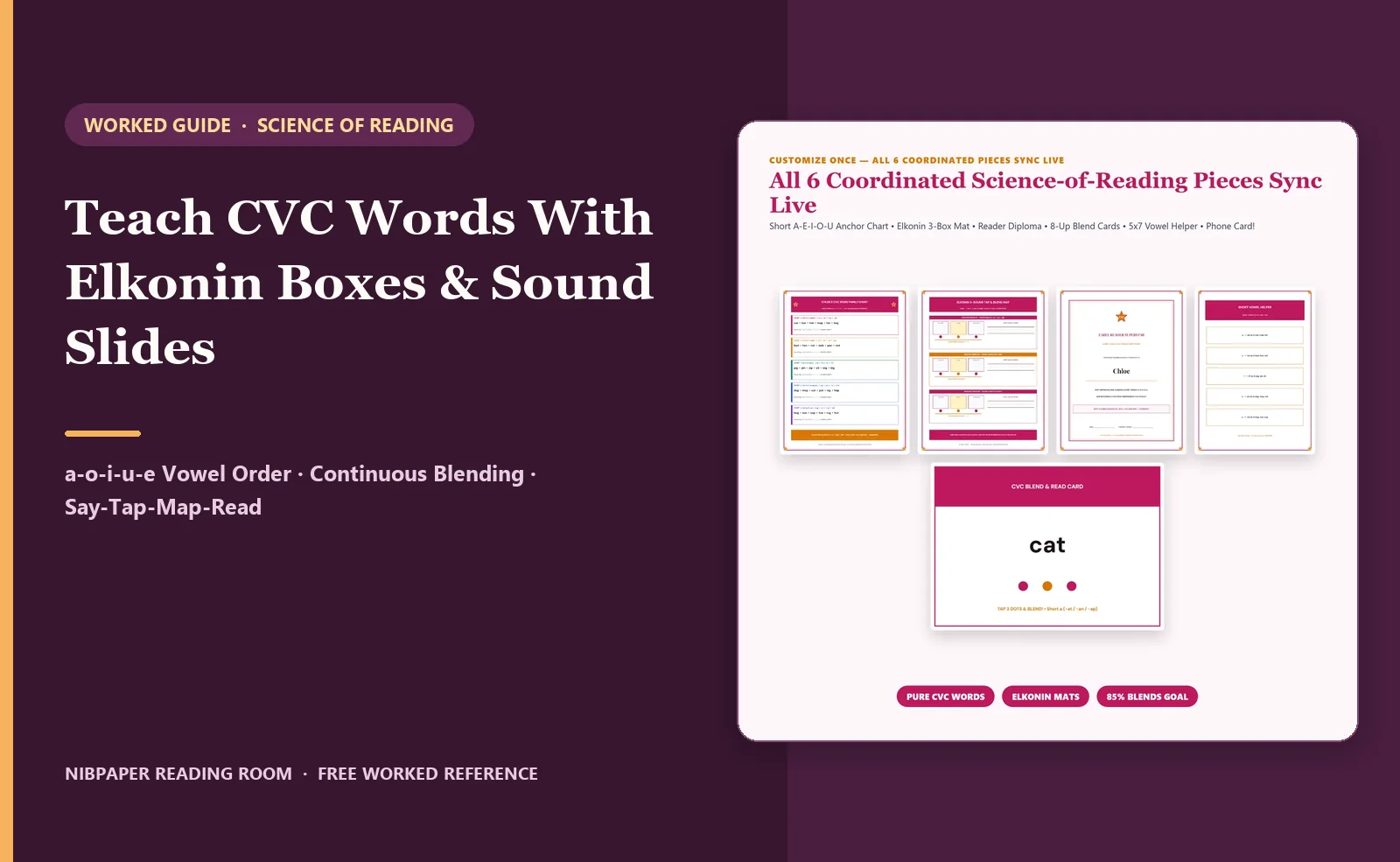
1. Why Alphabetical Vowel Order Trips Up Kindergarteners (Use a -> o -> i -> u -> e)
Teaching short vowels in alphabetical order (a, e, i, o, u) places short e (/ĕ/ as in bed) right beside short i (/ĭ/ as in pig), the two hardest vowels in English for 5-year-olds to tell apart. Both sit high at the front of the mouth and even sound nearly identical in many regional US accents (the classic pin vs. pen trap).
Structured literacy specialists separate short i and short e as far apart as possible by introducing Short a first (wide-open mouth: cat, map), Short o second (round open mouth: dog, hop), Short i third (tight smile: pig, sit), Short u fourth (relaxed jaw: sun, cup), and saving Short e for last (dropped jaw: bed, net) once blending confidence is already solid.
2. Fix Choppy Robot Reading With Continuous Sound-Slide Blending
Many beginners accurately say three separate letter sounds (/m/ ... /ă/ ... /p/) and then shout a random guess like 'man' or 'mug' because pausing between sounds forces their short-term memory to drop the beginning consonant. Adding an extra 'uh' schwa tail ('muh-ah-puh') makes blending even harder.
Start early blending with continuous consonants (m, s, f, n, l, r, v, z) that can be held smoothly without stopping airflow. Teach your child to glide their finger across a blending arrow under the letters and hold the first two sounds together without a gap (mmmaaa -> mmmaaap -> map; sssuuu -> sssuuun -> sun) before introducing quick stop sounds like /t/, /p/, /b/, and /k/.
3. The 4-Step Elkonin Box Routine (Say -> Tap -> Map -> Read)
Orthographic mapping is the brain process that anchors printed words into long-term sight memory through phoneme-grapheme connections, never by guessing from page illustrations. A simple laminated 3-box Elkonin mat plus three pennies, pom-poms, or play-dough balls turns a 5-minute kitchen-table drill into structured literacy:
- Step 1 (Say): Say one pure 3-sound CVC word aloud ('sun') and have your child repeat it clearly while noticing their mouth shape.
- Step 2 (Tap): Push one physical counter into each of the 3 sound boxes left-to-right while saying each pure phoneme (/s/ · /ŭ/ · /n/).
- Step 3 (Map): Clear the counters and ask 'What letter spells /s/?' so your child writes one letter inside each box (s | u | n) using a dry-erase marker.
- Step 4 (Read): Sweep a finger smoothly along the bottom blending line to slide the three sounds together and read the full word with zero guessing.
4. Defeating Short E vs. Short I Confusion & Knowing When to Start Digraphs
When short e finally joins short i in mixed review, hand your child a small mirror to feel the physical jaw drop: short i ('itchy igloo') holds a tight, high smile, whereas short e ('edgie elephant') drops the chin slightly lower. Practice quick oral minimal-pair sorts (pen/pin, pet/pit, net/nit, set/sit) with eyes closed before spelling them on paper.
Keep daily sessions brief (5 to 10 minutes) and playful using Dot-Marker Vowel Hunts, Scissor Cut-and-Paste Sorts, and Roll-and-Read dice games. Avoid rushing into digraphs (sh, ch, th) or consonant blends (st, fl) too early; wait until your reader decodes mixed short-vowel CVC words independently at roughly 85% accuracy across all five vowels.
Worked Example · Quick Reference
Science of Reading Short-Vowel Sequence, Mouth Cues & CVC Progression Matrix
| Teaching Stage | Focus Vowel & Families | Mouth / Anchor Cue | Daily 5-Min Drill & Mastery Target |
|---|---|---|---|
| Stage 1: Short a | -at, -an, -ap, -ag (cat, map, fan) | Wide open mouth ('apple') | Continuous blending with m, s, f, n + Elkonin 3-box tap |
| Stage 2: Short o | -og, -op, -ot, -ob (dog, mop, hot) | Round open 'O' ('octopus') | Contrast wide /ă/ vs. round /ŏ/ via Dot-Marker Vowel Hunt |
| Stage 3: Short i | -ig, -in, -ip, -it (pig, sit, zip) | Small tight smile ('itchy igloo') | Tap-Map-Write + Cut-and-Paste -at vs. -it word sorting |
| Stage 4: Short u | -ug, -un, -up, -ut (sun, cup, bug) | Relaxed mid-jaw ('up') | Roll-and-Read dice fluency + pure decodable mini sentences |
| Stage 5: Short e (Last) | -ed, -en, -et, -eg (bed, hen, net) | Jaw drops lower ('egg/elephant') | Mirror check + oral pen/pin & pet/pit minimal-pair sorts |
| Promotion Gate (>= 85%) | Mixed A-E-I-O-U (25 Pure CVC) | Independent left-to-right sweep | At >= 85% accuracy with zero guessing -> advance to sh/ch/th |
Educational early-literacy guide compiled by NibPaper Studio for parents and kindergarten teachers (not clinical speech-language pathology or dyslexia therapy). Always model crisp clipped consonant sounds (/t/, /p/, /m/) without adding 'uh' tails.
Save or share this guide
Pin it to your board for later or pass it along to someone who needs it.
Common Questions
Frequently Asked Questions
What is the best order to teach short vowels in CVC words for kindergarten?
Teach short vowels in a -> o -> i -> u -> e order instead of alphabetical a-e-i-o-u order. Starting with wide, distinct vowels (short a and short o) and saving short e for last puts maximum space between short i and short e, preventing classic pin/pen confusion while children build blending fluency.
Why does my kindergartener sound out all three letters correctly but say the wrong word?
Choppy pauses between sounds (/m/ ... /ă/ ... /p/) or adding an 'uh' tail ('muh-ah-puh') overload a 5-year-old's working memory before they reach the third letter. Switch to continuous blending with stretchable starter consonants (m, s, f, n, l) so they hold the first two sounds smoothly together (mmmaaa-p) into the final consonant.
When is a kindergartener ready to move from CVC words to digraphs and blends?
Wait until your child can independently tap, map, and blend mixed short a, e, i, o, and u CVC words at roughly 85% accuracy without picture clues or guessing. Reaching 85% mastery on pure 3-phoneme closed syllables ensures digraphs like sh, ch, th, and initial consonant blends click quickly.