Tarot Study Guide · 6 min read
How to Read All 56 Minor Arcana Tarot Cards Without Memorizing (Suit Elements, Numerology & 4 Reversal Lenses)
By NibPaper Studio · Print-tested · 2026-11-25
Why rote memorization stalls most beginner tarot readers at the Minor Arcana, plus the 3-second Suit + Number formula, 16 Court Card archetypes, Elemental Dignities, and 4 reversal lenses that unlock every spread.
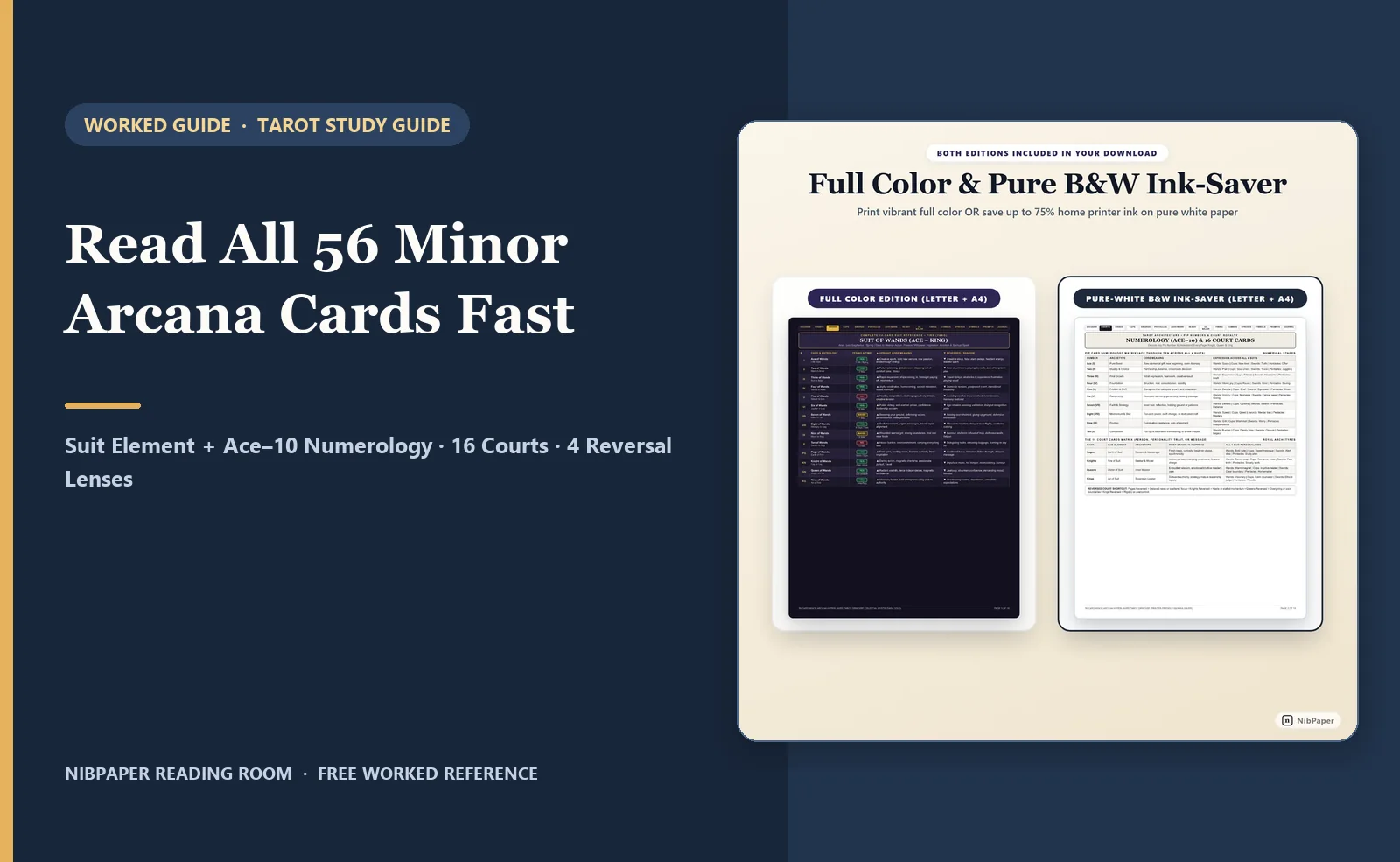
1. Learn the 4 Suits & Classical Elements First (Your Life-Area Compass)
While the 22 Major Arcana point to major life milestones, the 56 Minor Arcana track everyday decisions, conversations, work projects, and shifting moods. Rather than memorizing 56 separate paragraphs, anchor every pull to the four classical elements.
Each suit governs both a clear life domain and a traditional pacing speed in timing reads, so a single glance at the dominant suit in a 3-card spread immediately reveals whether the reading centers on action, feelings, thoughts, or tangible finances:
- Wands (Fire): Action, passion, ambition, creative drive, and enterprise (traditional timing speed: Days to Weeks).
- Cups (Water): Emotions, relationships, intuition, healing, and connection (traditional timing speed: Weeks to Months).
- Swords (Air): Intellect, communication, boundaries, truth, and mental conflict (traditional timing speed: Hours to Days).
- Pentacles (Earth): Material world, career, money, health, craft, and tangible results (traditional timing speed: Months to Years).
2. Combine Suit Element + Ace-Through-10 Numerology in 3 Seconds
Numbers 1 through 10 follow one continuous story arc across all four suits. An Ace always signals a raw seed or fresh opening, a Five introduces friction or a turning-point test, an Eight brings swift momentum or focused craft, and a Ten marks cycle completion or saturation.
Put the two halves together on any unfamiliar card: for example, Three of Pentacles combines Earth (work/craft) with Three (collaboration and initial expansion), immediately pointing to skilled teamwork and visible early results. Similarly, Five of Wands pairs Fire (ambition) with Five (friction), highlighting lively competition or clashing ideas.
3. Decode All 16 Court Cards Without Getting Confused
Court cards (Page, Knight, Queen, and King across all four suits) trip up beginners because they can represent another person, a role you are stepping into, or an emotional approach to a situation. Reading them by rank maturity removes the guesswork.
Pages act as the Student or Messenger (curious, fresh news, Earth of the suit); Knights act as the Mover or Seeker (fast action, pursuit, Fire of the suit); Queens act as the Inner Master (embodied, nurturing authority, Water of the suit); and Kings act as the Sovereign Leader (outward strategy, structure, Air of the suit).
4. Read Reversed Cards Calmly Using 4 Structured Lenses (Not Just 'Bad Luck')
Many beginners freeze when an upside-down card lands on the table because basic lists treat reversals as doom or pure opposites. In practical Rider-Waite-Smith reading, a reversed card simply shows how that card's energy is shifting direction.
Test four clear lenses against the surrounding cards in your spread: Blocked or Delayed (the upright spark hits a temporary hurdle, such as Ace of Wands reversed), Internalized (the emotion turns inward for private reflection), Excessive (too much of the suit's trait, such as a hasty Knight), or Releasing (pain or heavy tension finally lifting, such as Ten of Swords reversed).
Worked Example · Quick Reference
The 3-Second Minor Arcana Suit, Element, Timing & Numerology Reference Matrix
| Suit & Element | Core Life Domain | Ace (Seed) -> Five (Test) -> Ten (Completion) | Traditional Timing Speed |
|---|---|---|---|
| Wands (Fire) | Passion, action, career spark, willpower | Ace: Bold idea -> 5: Competition -> 10: Overcommitment burden | Fast (Days to Weeks) |
| Cups (Water) | Love, emotions, intuition, family | Ace: New feeling -> 5: Grief/regret -> 10: Emotional fulfillment | Moderate (Weeks to Months) |
| Swords (Air) | Mind, truth, words, decisions, conflict | Ace: Breakthrough -> 5: Ego clash -> 10: Definitive ending & dawn | Fastest (Hours to Days) |
| Pentacles (Earth) | Money, craft, body, property, legacy | Ace: Tangible offer -> 5: Financial pinch -> 10: Long-term stability | Steady (Months to Years) |
Traditional Rider-Waite-Smith study reference by NibPaper Studio for personal learning and reflective journaling. Always read individual cards alongside neighboring Elemental Dignities and your exact spread question.
Save or share this guide
Pin it to your board for later or pass it along to someone who needs it.
Common Questions
Frequently Asked Questions
What is the fastest way for a beginner to learn all 56 Minor Arcana tarot cards?
Instead of memorizing 56 separate definitions, learn just 14 core building blocks: the 4 Suit Elements (Fire, Water, Air, Earth) and the 10 Pip Numbers (Ace through 10), plus the 4 Court ranks (Page, Knight, Queen, King). Combining Suit plus Number lets you decode any card in a few seconds.
Do reversed Minor Arcana cards always mean something negative?
No. Reversed cards often point to delayed timing, private inner reflection, excessive energy, or relief from a difficult card. For example, Three of Swords or Ten of Swords reversed commonly signals healing, forgiveness, and releasing old stress rather than worsening hardship.
What is the difference between a Page, Knight, Queen, and King in tarot?
Pages represent curious learners, fresh messages, or early exploration; Knights represent fast movement, pursuit, and active momentum; Queens represent mature inward mastery and emotional confidence; and Kings represent outward leadership, strategy, and long-term structure within their suit's element.