Small Business HR & PTO · 6 min read
How to Track Employee PTO, Attendance Points & Bradford Factor Fairly (Without Penalizing FMLA)
By NibPaper Studio · Print-tested · 2026-11-24
A practical small-business HR framework for tracking 100-employee PTO carryover caps, true 0.5 half-days, fair customizable attendance points, and Bradford Factor (S²×D) disruption scores, while keeping planned PTO and legally protected FMLA strictly at 0.0 points.
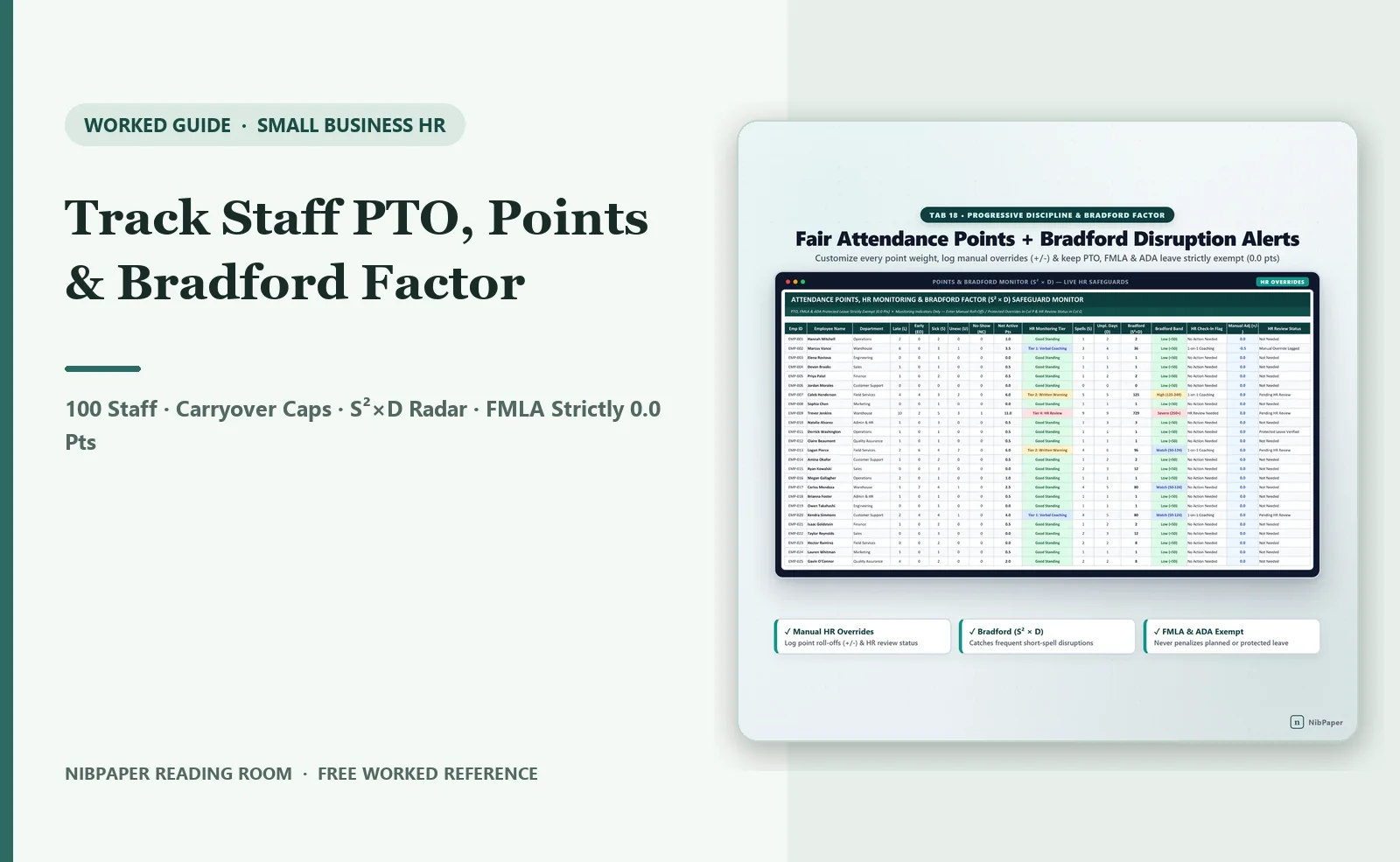
1. Lock Planned PTO & Legally Protected Leave Strictly at 0.0 Points
The fastest way a small-business attendance policy triggers legal risk or destroys team morale is running a blind point formula that penalizes every absence equally.
Under U.S. Department of Labor guidance for the Family and Medical Leave Act (FMLA), covered employers cannot count qualifying FMLA leave against an employee under a 'no-fault' attendance point policy, and similarly, ADA accommodations, jury duty, bereavement, and pre-approved PTO should stay strictly outside point accrual:
- Always 0.0 Points: Pre-approved PTO/Vacation, Protected FMLA, ADA-accommodated leave, Jury Duty, Bereavement, and Official Holidays.
- Configurable Point-Bearing Events: Unexcused Absences (U), No-Call/No-Show (NC), Unexcused Tardy (L), or Early Out (EO), each weighted clearly in your written handbook.
- Include Manual HR Overrides (+/-): Always keep a visible adjustment column and review status log for point roll-offs, doctor notes, severe weather, or state paid-sick-leave protections.
2. Track True Half-Days (0.5) & PTO Carryover Caps Explicitly
Basic spreadsheets that only accept whole numbers force managers to either over-deduct a full day when someone leaves at noon or track partial hours on sticky notes.
Using native 0.5 decimal Half-Day (HD) status codes keeps monthly attendance rates and payroll hours accurate, while an explicit PTO Accrual & Carryover Cap Ledger prevents year-end confusion by separating Beginning Carryover (capped per company policy), Current-Year Earned, Used, and Remaining balances per staff member.
3. Understand Bradford Factor (S² × D) as a Disruption Signal, Not an Automatic Punishment
The Bradford Factor formula multiplies the number of separate unplanned absence spells squared (S²) by total unplanned days absent (D). Why do HR teams watch S² × D? Because 5 separate single-Monday call-outs (5² × 5 = 125) disrupt daily shift coverage far more than one continuous 5-day flu recovery (1² × 5 = 5).
Treat Bradford bands strictly as an early coaching and check-in radar, never as an automatic disciplinary trigger without human review and protected-leave screening.
4. Watch Daily Shift Coverage Floors & Bring Objective 1-Page Report Cards to Coaching
In retail, clinics, warehouses, and customer support, total monthly attendance percentage hides dangerous single-day staffing dips (like a Friday where 6 staff overlap on PTO and drop coverage below your safe minimum floor).
Tracking a daily headcount floor catches low-coverage days weeks in advance, and printing an objective 1-Page Annual Employee Report Card keeps every 1-on-1 check-in calm, transparent, and factual.
Worked Example · Quick Reference
Bradford Factor (S² × D) vs. Total Days Comparison & Fair HR Safeguard Matrix
| Absence Scenario (12 Mos) | Spells (S) & Days (D) | Bradford (S² × D) | Recommended Fair HR Step |
|---|---|---|---|
| 1 Continuous 5-Day Flu Recovery | S = 1 spell · D = 5 days | 1² × 5 = 5 (Low) | No action needed: normal recovery |
| 2 Short Unplanned Absences (2d + 2d) | S = 2 spells · D = 4 days | 2² × 4 = 16 (Low) | Good standing: routine monitoring |
| 4 Separate Unplanned Call-Outs (6d) | S = 4 spells · D = 6 days | 4² × 6 = 96 (Watch) | Informal supportive check-in & verify causes |
| 5 Frequent Short Spells (5 single days) | S = 5 spells · D = 5 days | 5² × 5 = 125 (High) | Screen for FMLA/ADA/state sick leave -> 1-on-1 coaching |
| Approved FMLA or Planned PTO (10d) | Protected / Planned Leave | LOCKED AT 0 (Exempt) | Strictly exempt from points & Bradford calculations |
Organizational HR reference only, not legal or employment-law advice. Federal FMLA, ADA, and state/local paid sick leave laws strictly restrict penalizing protected absences. Always have a qualified employment attorney or HR professional review your written attendance policy.
Save or share this guide
Pin it to your board for later or pass it along to someone who needs it.
Common Questions
Frequently Asked Questions
Can an employer assign attendance points for approved FMLA leave?
Under U.S. Department of Labor FMLA guidance, covered employers may not count qualifying FMLA leave against an employee under a no-fault attendance point policy. Keeping protected FMLA, ADA accommodations, jury duty, bereavement, and pre-approved PTO strictly locked at 0.0 points prevents compliance mistakes.
How is the Bradford Factor (S2 x D) calculated and used fairly?
Multiply the number of separate unplanned absence spells squared (S x S) by the total unplanned days absent (D) over a rolling 12-month window. Use Bradford bands only as an early coaching and support check-in signal, always paired with human HR review and protected-leave screening.
Why does native 0.5 half-day tracking matter in a small business PTO log?
Whole-number spreadsheets force managers to either round a 4-hour medical appointment up to a full missed day or track partial hours manually elsewhere. Logging exact 0.5 half-days keeps PTO carryover balances, attendance percentages, and payroll estimates accurate.
Official Primary References
- Family and Medical Leave Act (FMLA): Employer & Employee Guidance(U.S. Department of Labor. Wage and Hour Division)