Time-Blocking & Daily Planning · 5 min read
How to Time-Block a Real Workday Without Burnout (Top-3 MITs, Flex Buffers & .ICS Sync)
By NibPaper Studio · Print-tested · 2026-11-24
Why back-to-back hour-by-hour schedules collapse by 11 AM, how to anchor your day around Top-3 Daily MITs, protect a 60-minute Afternoon Flex Buffer, switch to Minimum Viable Day mode on low-energy days, and push blocks straight to your phone via .ICS sync.
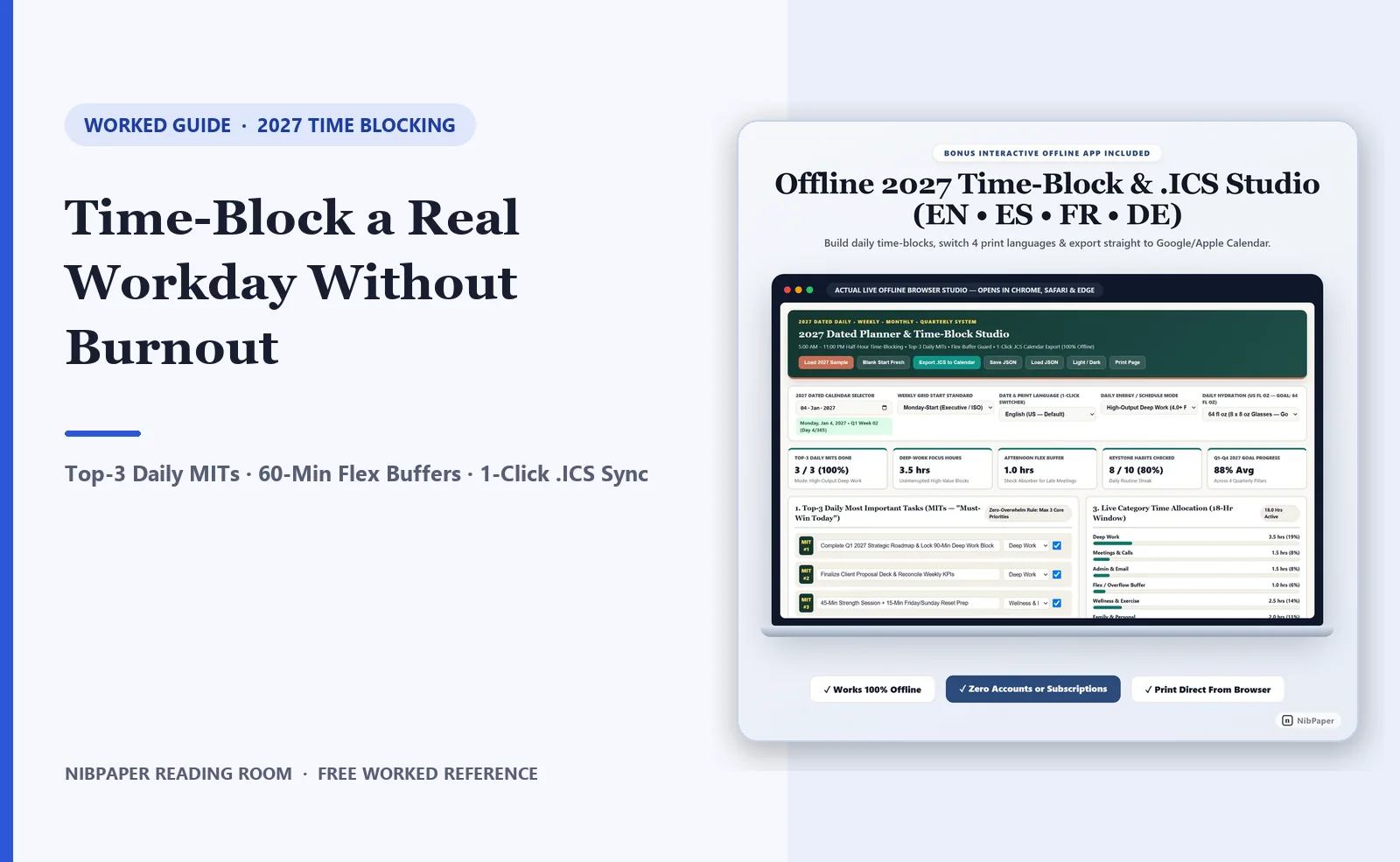
1. Replace the 25-Item To-Do List With a Hard Top-3 Daily MIT Ceiling
Most people quit daily planners within two weeks because they write 18 to 25 unranked tasks every morning, finish 11 of them, and end the night feeling behind. Limiting every workday to exactly 3 Must-Win Most Important Tasks (MITs) flips that psychology completely:
- Schedule MIT #1 First: Place your single hardest deep-work deliverable in your highest-energy 90-minute morning window BEFORE opening email or Slack.
- Batch Shallow Admin Together: Group messages, quick calls, and errands into one bounded 60-minute midday or late-afternoon block instead of letting them shatter focus all day.
- Everything Else Is Bonus: Once your Top-3 MITs are checked off, your workday is already a win, any extra tasks completed are calm upside.
2. Always Guard a 60-Minute Afternoon Flex Buffer (Your Schedule Shock Absorber)
Rigid time-blocking fails because real life never runs on railroad tracks: a client call stretches 20 minutes over, a child's school calls, or a software update stalls your laptop.
Leaving one intentional 60-minute 'Flex / Overflow Buffer' around 2:00 PM or 3:30 PM absorbs delays cleanly, instead of triggering a domino collapse across the rest of your afternoon and evening.
3. Switch to 'Minimum Viable Day' (MVD) Mode on Low-Energy or ADHD-Brain Days
Exhausted, sick, or brain-fog days are where perfectionist planners cause multi-week abandonment. Instead of staring at an intimidating 18-hour grid, drop straight into a 3-step Minimum Viable Day (MVD) sheet: pick 1 non-negotiable survival priority, 1 tiny 10-minute reset (hydrate, stretch, clear one inbox thread), and permission to stop early, preserving momentum without guilt.
4. Bridge Paper/Tablet Planning & Phone Alerts Using 1-Click .ICS Export
Planning on paper or an iPad is unbeatable for clear thinking, but paper cannot tap your wrist when it is time to start a 90-minute deep-work sprint.
Exporting your planned blocks as a universal .ics calendar file imports them straight into Apple Calendar, Google Calendar, or Outlook in two seconds, giving you calm tactile planning PLUS automatic phone notifications with zero monthly planner-app subscriptions.
Worked Example · Quick Reference
Realistic 5 AM–11 PM Hybrid Workday Time-Block Blueprint (High-Output vs. MVD Mode)
| Time Window | High-Output Workday Block | Minimum Viable Day (MVD) | Why It Holds Up |
|---|---|---|---|
| 6:30–8:00 AM | Morning Anchor, Coffee, Walk & 10-Min Plan | Gentle Wake, Hydrate & Pick 1 Priority | Starts the day intentionally before inbox noise |
| 8:30–10:30 AM | MIT #1: 90–120 Min Uninterrupted Deep Work | Single 45-Min Non-Negotiable Focus Sprint | Protects peak cognitive energy for highest-value work |
| 10:30 AM–12:00 PM | Meetings, Client Calls & MIT #2 Progress | Handle Urgent Replies Only (30 Min Cap) | Keeps collaboration contained in one crisp slot |
| 1:00–2:30 PM | MIT #3 + Batched Email / Admin Block | Light Routine Admin or Rest Break | Prevents constant context switching every 10 minutes |
| 2:30–3:30 PM | 60-Min Afternoon Flex / Overflow Buffer | Open Recovery / Early Shutdown Window | Shock absorber for late meetings & surprise tasks |
| Friday 4:30 PM | 12-Min Zero-Guilt Weekly Reset & Next-Week .ICS | Migrate Unfinished Items Calmly to Monday | Clears mental clutter before the weekend starts |
Productivity framework built and tested by NibPaper Studio. Adjust start/end hours smoothly across the 5:00 AM–11:00 PM window to fit early risers, shift schedules, or night owls.
Save or share this guide
Pin it to your board for later or pass it along to someone who needs it.
Common Questions
Frequently Asked Questions
Why do rigid hour-by-hour daily planners fail before lunchtime?
Packing tasks back-to-back from 8 AM to 5 PM leaves zero slack for a single late meeting, urgent phone call, or tired afternoon. One 15-minute slip pushes every remaining block off schedule and makes people abandon the planner altogether.
How does a 60-minute afternoon Flex Buffer save your schedule?
Leaving one intentionally unscheduled 60-minute buffer block mid-afternoon absorbs late meetings, urgent messages, and spillover tasks without touching your morning deep-work focus block or stealing your evening recovery time. When days run smoothly, that extra hour becomes a calm wrap-up window.
What is a Minimum Viable Day (MVD) plan?
A Minimum Viable Day trims your schedule down to just 1 to 3 essential tasks on sick days, high-stress days, or low-energy afternoons. Finishing a smaller realistic plan keeps your momentum steady instead of turning one hard day into a lost week.