Family Preparedness · 5 min read
How to Build a Zero-Password 'In Case Anything Happens' Emergency & Executor Binder
By NibPaper Studio · Print-tested · 2026-11-22
Why writing raw passwords in a paper death binder backfires, plus the 4 steps every household should prepare first for sudden hospitalizations, beneficiary overrides, and executor handoff.
1. Never Write Raw Passwords or Full SSNs in Ink on Paper
The biggest flaw in traditional 'in case I die' books is encouraging families to write raw banking passwords, email logins, 2FA recovery codes, and full 9-digit Social Security numbers onto notebook pages.
If that binder is misplaced or photographed during a move or home repair, your entire household is exposed. Use a pointer-only Digital Legacy Locator instead:
- Keep actual logins inside an encrypted password manager and store its printed Emergency Recovery Kit inside a locked fireproof safe.
- Set up an official Apple Account Legacy Contact and Google Inactive Account Manager so photos, email, and cloud drives are never permanently locked.
- In your binder and spreadsheet, record only where the safe and Recovery Kit live, which institution holds each account, and Last-4 account references.
2. Prepare a First 48-Hour Living Incapacitation Plan (Not Just End-of-Life)
Most emergencies are sudden hospitalizations, surgery recoveries, or ICU stays where you are alive but temporarily unable to pay bills, contact HR, or care for kids and pets.
Put a dedicated First 48-Hour Living Incapacitation Plan right at the front of your binder clearly separating Emergency Contacts (who have zero legal authority) from signed Healthcare POA and Durable Financial POA agents.
3. Audit Non-Probate Beneficiaries Before They Override Your Will
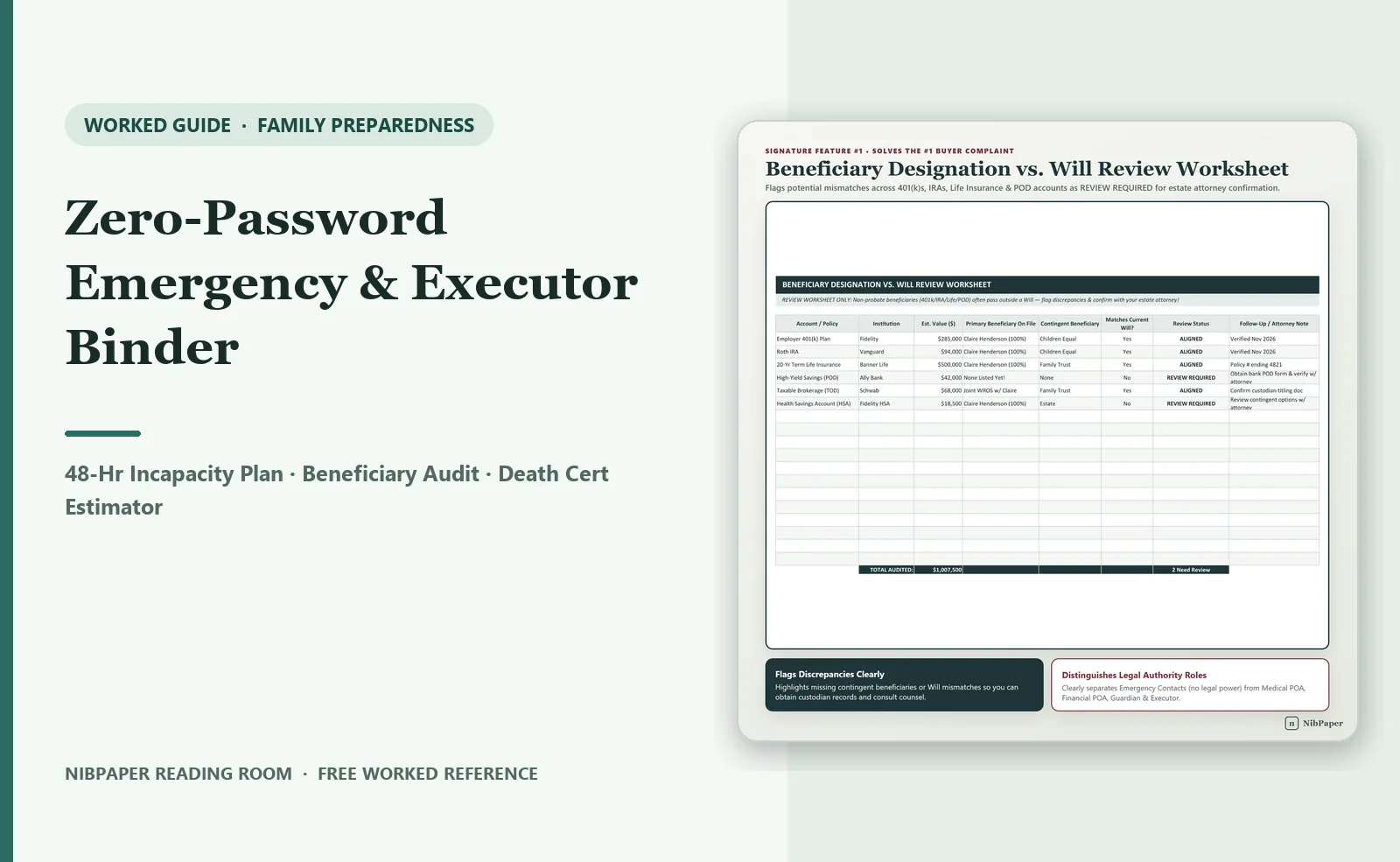
Many families update their Will after marriage, divorce, or the birth of a child, and assume every asset follows that Will. In the US, beneficiary forms on 401(k) plans, IRAs, HSAs, life-insurance policies, and Payable-on-Death (POD) bank accounts typically pass outside probate and override a Will.
Listing every non-probate account side by side once a year lets you spot missing contingent beneficiaries or mismatches early and confirm official custodian records with a licensed estate attorney.
4. Estimate Certified Death Certificates & Map Monthly Autopays Calmly
Executors frequently get stalled mid-probate because they ordered too few raised-seal certified death certificates upfront or missed recurring subscriptions draining a checking account.
Counting each life-insurance carrier, real estate deed, bank, retirement custodian, vehicle title, and probate filing in advance (paired with an Autopay Stop-List and a calm 24-Hour, Week 1, and 30/60/90-Day Executor Roadmap) spares loved ones months of administrative stress.
Worked Example · Quick Reference
4-Pillar Zero-Password Emergency & Executor Handoff Reference
| Preparedness Pillar | What to Document Safely | What to NEVER Write in Plaintext | Recommended Review |
|---|---|---|---|
| Zero-Password Digital Legacy Map | Password manager name, fireproof safe location of Emergency Kit, Apple/Google Legacy Contacts | Raw bank/email passwords, master password, 2FA backup codes, PINs, or full 9-digit SSNs | Every 12 months (tax season) |
| First 48-Hour Living Incapacity Plan | Healthcare Proxy/Medical POA, Durable Financial POA, childcare/pet handoff, critical autopay bills | Assuming an unlisted Emergency Contact can access bank accounts or sign medical orders | After any life, job, or medical change |
| Beneficiary-vs-Will Audit Sheet | 401(k), Roth/Traditional IRA, HSA, Life Insurance, POD/TOD primary & contingent names + Last-4 | Relying on memory instead of official custodian records & state-specific attorney review | Annually & after marriage/birth/divorce |
| Death Certs & 24H–90D Executor Plan | Count of policies, deeds, banks & titles + 2–3 buffer copies, Autopay Stop-List, Debt Attorney review | Guessing copy counts or paying sole-name debts personally before consulting probate counsel | When buying/selling property or accounts |
Personal organizational reference only, NOT a Last Will and Testament, Living Trust, Power of Attorney, Advance Directive, or legal/tax/financial advice. Estate administration, beneficiary overrides, and spousal debt rules vary strictly by US state; always consult a licensed estate-planning attorney and CPA in your state.
Save or share this guide
Pin it to your board for later or pass it along to someone who needs it.
Common Questions
Frequently Asked Questions
Should I write raw bank and email passwords inside a paper emergency binder?
No. Writing plaintext passwords in a physical binder creates serious identity-theft risk if the binder is ever lost or stolen. Instead, list account institutions, last 4 digits, your password manager name, and who holds your offline Emergency Access Kit or master vault instructions.
What is the difference between a 48-Hour Incapacity Plan and an Executor Checklist?
A 48-Hour Incapacity Plan helps your family handle immediate logistics if you are suddenly hospitalized (pet care, childcare, employer contact, urgent autopay bills, Healthcare POA). An Executor Checklist guides probate, death certificate copies, and account closures after a passing.
Why should beneficiary designations be audited separately from a will?
Accounts with named beneficiaries (such as 401(k)s, IRAs, life insurance, and Transfer-on-Death brokerage accounts) generally pass directly to the listed beneficiary outside of probate and can override instructions written in a will. Reviewing them once a year prevents outdated designations.
Official Primary References
- Official Checklist After the Death of a Loved One(USA.gov)
- Advance Care Planning & Healthcare Directives Guide(National Institute on Aging (NIH))